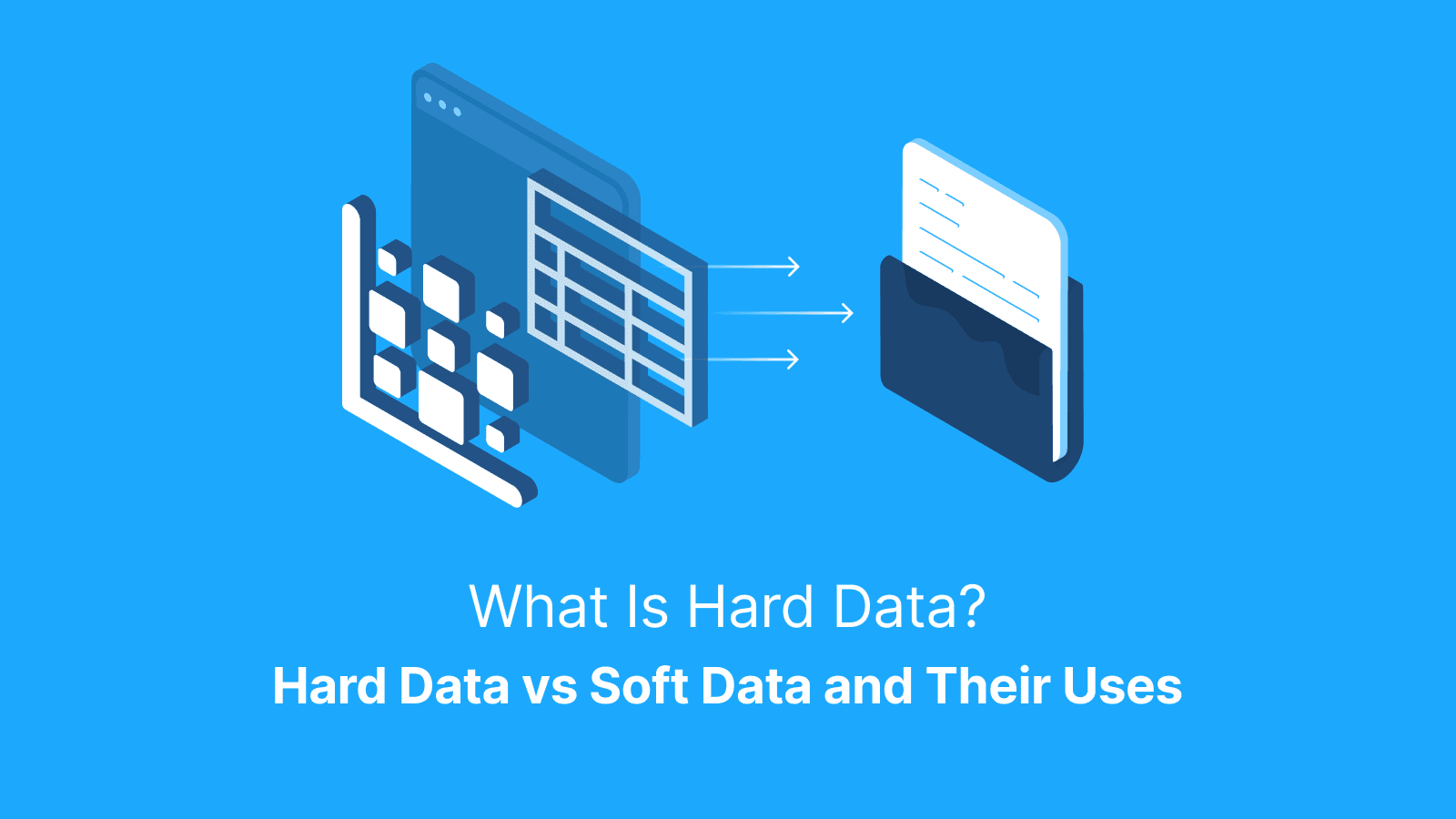

Confused about the hard data's meaning? You’re not alone! Hard data is quantitative information measured through defined methods that can be verified and reproduced when the same method and access are used. Soft data, on the other hand, captures perceptions, intent, and qualitative feedback. It’s often collected through surveys, interviews, and open text inputs
You must have tried to make a decision based on your gut feeling, but you were proven wrong by hard facts. That's the difference. This split between hard and soft data matters because every major decision depends on it. In business, choosing a product requires verifiable signals. Marketing teams need to have early directional clues. Finance relies on audited metrics to manage risk and avoid losses.
This guide explains the difference between hard and soft data, providing a clear comparison. You'll understand when to trust each type, how to combine them, and how to collect data from public sites. You’ll also get to know the mistakes you can avoid, different examples, and where IP proxies come in.
What Is Hard Data?
Hard data is factual, numeric information that you can obtain through a documented and repeatable method. Therefore, if two people measure the same thing in the same way, they should obtain the same result. This is simply how hard data works.
For example, think of the monthly sales you record in a ledger or the number of device error counts per hour. These figures are specific and can be measured.
How do you recognize data with hard numbers?
- A clear metric definition: Think about what exactly you're measuring.
- A known unit: Is it dollars, seconds, percentage points, or units sold?
- A time stamp: When was this measurement taken?
- A named source: Where did this data come from?
- Reproducibility: Can you repeat the same process and obtain a similar result?
Hard Data Definition vs Any Number
Not every number qualifies as hard data. For example, the number you input into a spreadsheet by guessing is not hard data. Real hard data comes from a stable instrument or a documented process. A server log count or a consistently implemented analytics event can be hard data. A manager's estimate of traffic is not. When measured the same way, hard data should be consistent within expected measurement error and documented revision rules.
Which Type of Data Consists of Hard Numbers?
Hard numbers appear in domains that depend on precision:
- Finance: Can be identified by recognized revenue, cash balance, profit margins, and tax figures.
- Operations: Delivery time in hours, production defect rate, and inventory cycle counts.
- Web Analytics: This can produce hard metrics when definitions are fixed. Examples include event counts and sessions under a defined method. Document identity and attribution assumptions because ‘unique users’ can vary by setup.
What Is Soft Data?
Soft data captures perception and intent. It's qualitative in nature, unlike hard data that's quantitative and measured. It can be mostly gathered from surveys, interviews, usability sessions, support chats, open text, and social posts.
Most times, Soft data can surface issues early. However, it should be tested against hard metrics because it can lead or lag depending on the context. People notice any friction even before metrics change. Soft data explains the why, while hard data explains the what and the how much.
Common Soft Sources
Readers can collect soft data instantly by pulling:
- CSAT (Customer Satisfaction Score) and NPS (Net Promoter Score) surveys.
- Usability testing notes and session recordings.
- Panel discussions.
- Social listening tools track brand mentions.
- Open-text feedback from support tickets.
Strengths and Limits of Soft Data
Soft data typically provides more context and is easier to understand. You can gather them faster than hard data and fast. It works best for forming hypotheses and generating new ideas. However, it doesn't settle high-stakes decisions on its own. You should avoid making high-stakes decisions, especially when money, compliance, or safety are at stake.
Soft Data vs Hard Data: What Is the Difference?
Here's how soft data vs hard data are different:
- Nature: Hard data is a measured fact; soft data is an expressed opinion.
- Method: Hard data is captured through instrumentation, while soft data is collected through human responses.
- Timing: Hard data can be real-time or delayed depending on instrumentation and processing. What makes it “hard” is measurability and auditability, not speed. Soft data arrives quickly but is directional.
- Bias: Hard data usually avoids survey response bias. However, it can still be biased by instrumentation gaps, definitions, bot traffic, and sampling. While soft data has higher variability.
- Best fit: Hard data suits compliance and finance. Soft data suits discovery and messaging.
Accuracy, Bias and Timing
It’s slow to gather hard data, although it’s more verifiable and objective. For soft data, it’s faster to obtain. You’ll have to map them based on decisions. Hard data works for sign-off and performance reviews, while soft data works for early-stage research and message testing.
When Numbers Mislead
If you aren’t careful, even hard data can mislead or be deceptive. For example, if an “active user” changes, it could affect your numbers. While the figures look precise, they may lead to the wrong conclusion. Ensure you publish all metrics and note when you notice any changes.
When Should You Rely on Hard Data?
For high-stakes decisions, prioritize auditable hard metrics where possible. Use soft data to explain causes and guide what to measure next.
Examples include financial close, service level reports, clinical performance metrics, and performance bonuses. In these cases, soft data explains why a number is what it is. However, final decisions should be based on auditable numbers.
When Soft Data Should Lead
Use soft data in the early stages of exploration. Cases like user research, message testing, and UX reviews. Perception often comes first, followed by numbers. After launch, your goal should be to convert those ideas into hard measures that could track progress over time.
Picking an Anchor Metric
For any major decision, pick one major hard metric. Keep it stable. This stability protects teams from shifting targets. It makes it easy to read long-term trends.
How Do You Combine Hard and Soft Data?
The best approach is to use a simple, continuous loop:
- Start with a soft signal that suggests a problem.
- Translate to hard metrics with written definitions.
- Run a time-aligned check to determine whether the signal tracks the outcome.
- Decide and act
- Review and adjust
Monitor the hard drop-off metric weekly. If it improves, keep the change. If not, revisit your hypothesis. Keep this loop short and visible. This way, it's easy to learn and adapt quickly.
Triangulation Checklist
When comparing soft and hard data, ensure you're comparing for proper alignment:
- Use the same time window for both data.
- Align audience segments. For example, don't compare feedback from new users with metrics from all users.
- Document your methods for gathering both.
- Keep a short memo of your assumptions so a teammate can reproduce the analysis.
From Insight to Change
Let’s give an instance: If users say that your checkout is confusing. This is soft data. Suppose the funnel shows a 40% drop-off in shipping. This is hard data. You decide to remove one field (action). Then, the next week, the drop-off rate reduces to 25%. This means that you’ve been able to change a complaint into an improved measurement.
How Can You Collect Clean Hard Data From The Public Web?
Many teams build operational datasets. They gather hard data from public websites regarding prices, product availability, and local search results. However, it involves managing risks such as:
- Location bias that shows you the wrong prices or content.
- Being blocked by anti-bot systems.
- Dynamic content that loads values after the initial page load.
- Layout drift, where a website update breaks your data collection.
However, to create a simple collection, you should:
- Define the fields and the HTML/CSS selectors you'll use to extract them.
- Sample and validate a small batch of data early
- Log all failures and their reasons (e.g., "blocked by CAPTCHA," "selector not found").
- Store source snapshots for auditing. Can be HTML or screenshots
- Schedule reruns with change detection. This ensures differences in data are real and not caused by scraping errors.
How IP Proxies Help
To collect accurate hard data from the web, you often need to see the internet as a local user does. This is why you need IP proxies:
- Location Accuracy: Using a rotating residential IP from a specific city ensures you see the same localized pricing. You can also see search results and ad campaigns in your area.
- Session Stability: A static IP address reduces forced logouts. It prevents the creation of incomplete records that skew your data.
- Lower Block Rates: Blocks and CAPTCHAs can create success-rate bias by dropping the hardest pages from your dataset. Rotation and polite pacing can reduce this risk, but they do not remove it.
Live Proxies for Hard Data Collection
Live Proxies is a proxy provider with both B2C and B2B options, built for hard data collection workflows where you need stable sessions, reliable geo coverage, and clean IP allocation. It supports HTTP by default, with SOCKS5 available upon request. It also supports sticky sessions that can last up to 60 minutes, unlimited threads, and 24/7 support.
Where Live Proxies fits best for hard data collection:
- Location-accurate measurement: collect pricing, availability, and local SERPs as a real user would see them in a specific city
- Session stable collection: keep one IP for logged-in checks so your dataset does not get broken by forced logouts
- Rotation for scale: distribute requests across many IPs to reduce blocks and avoid success-rate bias in your dataset
- Cleaner sampling with private allocation: keep your assigned IPs isolated so repeated measurements stay consistent and less noisy
- Longer-term consistency: use static residential options when you need the same home IP to remain stable over time
Proxy Hygiene Basics
- Use endpoints that match the region you’re measuring.
- Keep your cookies stable for logged-in flows.
- Rotate IPs between page loads, not just during a single session.
- Track cost per successful row. This encourages optimization for clean data, not just speed.
Further reading: Why Ad Verification Requires Precise IP Geolocation and What Are Mobile Proxies and How Do They Work? Pros and Cons.
How Do Hard Data and Proxies Relate in Practice?
Proxies support hard measurement in three areas:
- Price and availability tracking
- Search and map results
- Ad verification
With an accurate location, you can improve your dataset's validity.
Example: Price Index by City
Let's give an example of the price index by city. Let's say a company wants to build a competitive price index for any product. They collect the product page across five different cities using residential IPs. They log the final price, which normally includes tax and shipping since these are often location-specific.
This is hard data revealing what a local buyer actually sees.
Example: QA for Logged-in Content
For login flows, keep the session stable for the full check, and avoid switching identities mid-flow unless the test requires it. This can help to avoid session churn that produces misleading dropoffs.
How Do You Judge Data Quality So That Hard Data Stays “Hard”?
Do quality checks: It needs to include definitions and stable units, and a consistent timestamp with zones. The completeness rate, error rate, revision notes, and a short data dictionary are not excluded. Each chart has to have its source and the period it covers. Records are to be checked by teams to make sure that the number reflects what people believe.
Revisions and Versions
Note that data changes. Then save both the first release and the latest values with their days. This allows people to see how the data grows.
Comparability Across Regions
Try to define your metrics consistently. If you have different markets, don’t add them together. You can compare them side-by-side by labeling them with their differences.
Why Can Soft Data Outperform Hard Data in Early Signal?
The top indicator is human perception. A dip in customer confidence can show up while conducting your survey data weeks before lower sales appear. Use soft data to flag risks and focus your attention. Then, confirm with hard data.
False Alarms
On the flip side, soft data from small samples can swing wildly. First, ensure that the data is smooth before you wait for confirmation from the next hard data reading.
Convert to Hard Goals
Translate your soft data to make it actionable. An “ease of use” can be a “time to complete checkout”.
Where Do Teams Misuse Hard Data?
The common mistakes which people make while misusing hard data include:
- Moving the goalposts: This is when people change the definition of a metric. They want to make their performance look better.
- Cherry-picking date ranges: Choosing a time frame that supports a desired narrative.
- Mixing metrics: When you add up numbers with different definitions.
- Ignoring uncertainty: This is a situation where one considers a point estimate as exact, even when there is a margin of error.
Establish a habit of writing metric specs and keeping them stable for the entire quarter.
Anti Cherry-Picking Habits
- Focus on the metric and its time window before reviewing results.
- Show complete series
- Label your axis correctly and make sure they are readable.
Guardrails for Dashboards
Label every one of your metrics with its definition and version. Link to a one-page data dictionary and add an updated timestamp and a link to the data source.
How Can You Present Hard and Soft Data Together?
A one-slide structure usually works well:
- Lead with the key hard metric: For instance, "Q3 Sales: +15% vs. last quarter."
- Add one soft data point: "Customer surveys cite 'faster delivery' as the top reason for satisfaction."
- Close with a decision and next step: "Decision: Continue the expedited shipping program. Next Step: Evaluate cost impact by EOM."
Visuals That Clarify
Use paired charts with aligned dates. The top panel should show the hard metric, e.g., sales. The bottom panel could show a soft index, e.g., sentiment score. Add small notes referring to real-world events, such as the release or launch of a campaign.
Copy That Builds Trust
Include the source, time period, and metric definition in one clean line beneath each chart. Avoid vague acronyms and unexplained labels to improve clarity.
How Do Hard and Soft Data Apply by Function?
They could apply by:
Product and UX
Use soft data to detect pain points early. Validate improvements with funnel metrics, task completion time, and error frequency. You can release small changes first. Then, record what worked and what did not.
Marketing and Brand
Employ surveys and social listening to understand how the message fits and the audience's mood. Confirm shifts with the rate of repeat purchases, lead quality, and branded search share. Your messages should focus on goals that are measurable.
Finance and Ops
Keep hard measures for cash, margin, unit cost, and service levels; use soft signals-employee feedback, customer complaints. This anticipates risks and decides where to add operational buffers.
How Can You Build a Simple Hard Data Pipeline?
Follow this simple sequence:
- Identify your source. This could be a public website you want to use in order to measure pricing.
- Write extraction rules
- Validate on a small sample.
- Store raw and processed data.
- Transform data into a clean table with consistent units and timestamps.
- Creating a basic dashboard
- Write a short runbook so someone else can operate the pipeline.
Roles and Ownership
Start with one metric before expanding. You can assign clear ownership: One person publishes, one person approves, one person fixes the brakes. List a backup operator so you won't experience delays.
Documentation That Saves Time
Keep a lightweight spec: definition, unit, source, method, and caveats. Store it beside the dashboard for easy access.
How Can You Keep Your Collection Ethical and Legal?
Just because you can access a public page doesn't mean you are free to use all its data as you like. Follow website terms and applicable laws. Treat robots.txt as an access guideline and align your collection approach with internal policy. Also, avoid high request rates that degrade service. Use polite pacing and back off on errors or CAPTCHAs. Avoid mixing your personal account logins with those of third-party scraping tools. Make sure you prioritize privacy right from the beginning.
Privacy Basics
Minimize collection of personal data. Avoid collecting PII unless it is necessary and permitted, and apply retention limits.
Rate and Respect
Pace your requests and back off if you encounter errors or CAPTCHA. Using a steady approach provides you with long-term access. It can improve the quality of your data.
Further reading: What Is Data Retrieval, How It Works, and What Happens During It? and What Is an Open Proxy? Risks, Examples and Alternatives.
Why Do Definitions Matter More Than Charts?
Without shared definitions, charts confuse more than they clarify. Start every reporting cycle by locking metric names, units, and windows. With metadata stable, teams can focus on business meaning rather than debating labels.
One-Page Data Dictionary
Keep terms, formulas, and sources on one shared page. Update it whenever anything changes. Link from every dashboard.
Change Control
Announce definition changes early. Run old and new versions in parallel briefly. Switch once validated and archive the retired version with a clear date.
How Can You Transform “Soft” Data Into “Hard” Action?
Here's what you should do:
- Specify the three most frequent feedback/complaints
- Translate each into a measurable behavior or outcome.
- Run a small test to improve the metric.
- Measure change using stable instrumentation.
- Keep improvements that move the anchor metric.
After having made this change, go back. Resurvey a small group to check whether the perception has improved. Check your hard metrics to confirm that the outcome indeed has improved.
Example Mapping
- Slow support replies → first response time in minutes.
- Confusing pricing → quote-to-close time in days.
Close the Loop
After making changes, resurvey a small group to confirm perception gains. Check hard metrics to confirm outcome gains. Share both to create a complete story.
What Tools Assist With Hard and Soft Data?
While choosing, think in terms of tool categories and not just brand names. Some of these tools include:
- Source control for metric definitions and scripts.
- ETL stands for Extract, Transform, Load tools.
- Storage for raw and processed data.
- BI platforms for dashboards and charts.
- Survey tools for soft data collection.
- Note-taking Apps for memos and decision logs.
Pick tools based on latency needs, scale, governance, and auditability rather than hype.
Latency vs Truth
Real-time isn’t always necessary. Batch processing can be easier to audit and more stable, but correctness depends on your instrumentation and QA. Choose your fresh data based on how quickly you need to make a decision.
Audit Trail
While you’re building your database from the web, keep snapshots to support traceability if numbers are questioned. Save URL, timestamp, and the raw capture used to compute the metric.
Bottom Line
Hard data tells what happened and how much it mattered. Soft data tells why people reacted the way they did; it also explains what they're likely to do next. Therefore, when it comes to using data, use soft information to discover, and hard information to decide.
When gathering hard data on public sites, make use of well-managed IP proxies. Your measurements reflect the actual conditions of the region.
FAQs
What Is Hard Data?
Hard data is objective, verifiable, measurable information. Usually, one set of hard data gives the same result each time. It includes values such as daily revenue or error counts per hour, where anyone following the same procedure will capture the same number. Numbers should have units and timestamps, along with methods for those units and timestamps, so that others can replicate them. As a next step, document all metric definitions on one shared page so your team always knows exactly what each number means.
What Is Soft Data?
Soft data are human opinions, perceptions, and interpretations. Examples include survey responses like, "I find the interface confusing," and interview feedback like, "The pricing feels unclear." Your results might shift if the context changes. A practical next step is to set a validation plan that checks whether soft signals correlate with future behavior.
What Is the Difference Between Soft Data vs Hard Data?
Hard data relies on instrumentation and stable methods, while soft data relies on human responses. Hard data changes slowly and is suited for financial, compliance, and operational decisions. Soft data moves quickly and helps teams discover issues early. For your next action, choose one anchor hard metric and one soft signal to track side by side.
What Type of Data Consists of Hard Numbers?
You will mainly notice hard numbers appearing in the fields of finance, operations, and official statistical reporting. Hard data might include revenue, cash flow, delivery times, or even unemployment rates. These are mainly metrics that you can quantify. To improve reliability, add units and time stamps to every report your team publishes.
How Do Proxies Help in Collecting Hard Data From Websites?
Proxies give location-accurate IPs. This is so that websites can display the same content a real local user would see. They also maintain session stability and lower block rates, which reduces gaps in datasets. They help to make sure that prices, availability, and search results reflect true local conditions. A simple next step is to test one city-targeted IP on a small sample using polite request pacing.
How Do I Validate Soft Data Against Outcomes?
Perform a lag check by matching the timing of a soft data against a hard one. Look for those correlations wherein changes in soft data happen before changes in hard data. For example, check whether negative sentiment rises before return rates rise. This lag check tells if perception precedes reality. As a next step, schedule a two-sprint review to see whether the relationship holds over time.
How Do I Make Soft Data More Reliable?
You can increase realiability by using standardized questions, ensuring that your sample represents your entire user base. You can also have multiple people code open-text responses into consistent tags to reduce individual bias. Start your next step by publishing the response rate of your sample demographics next to any soft data result you share.
How Do I Keep Hard Data Trustworthy?
Document your definitions and keep an audit trail of raw data. Also, create new versions of metrics when your collection methods change. For your next project, create a one-page data dictionary for your team or project.
When Should Soft Data Lead Decisions?
Let soft data lead in the discovery phase, during message and concept testing. It can also be in pre-launch UX reviews. They are where feelings and perceptions are the primary indicators of potential success. Therefore, for your next soft-data project, design the hard metric you will use to confirm the change you worked on after launch.
What Are Common Mistakes With Hard Data?
The most common mistakes are moving the goalposts. This involves changing your metrics mid-stream. Other mistakes include cherry-picking favorable date ranges and mixing numbers that have different definitions. This creates a false sense of precision. A valuable next step is to lock a quarterly metric specification and commit to it for the full period.