
Have you ever spent countless hours building profiles, running ads, and carefully nurturing every interaction—only to see everything disabled overnight? Many people assume it happens only because of content violations.
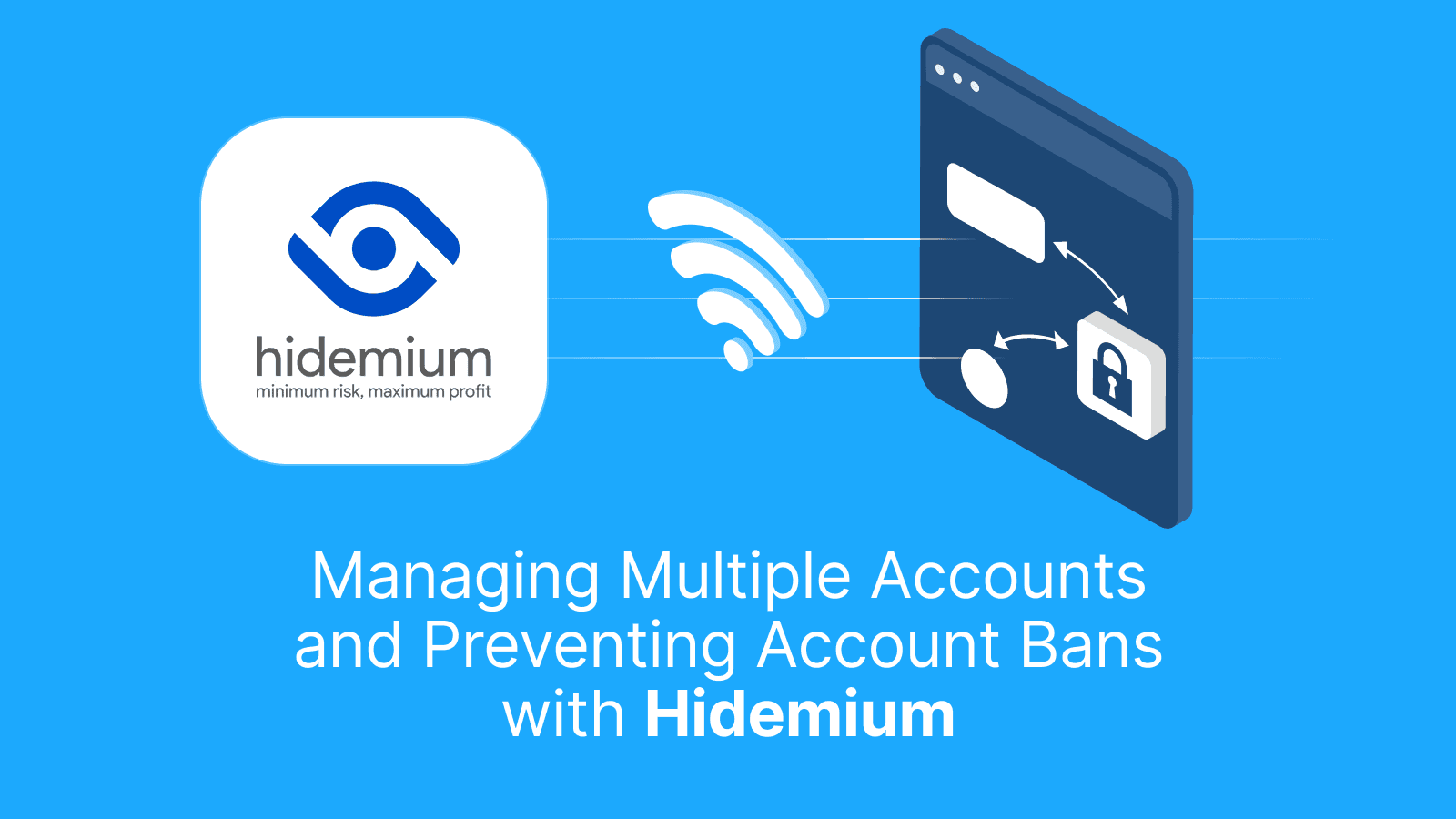
In practice, major platforms also evaluate technical and behavioral risk signals. They can link activity through device and browser fingerprints, which are built from multiple signals beyond the IP address. This article explains why multi-account operations get flagged more often and how to use Hidemium as a profile-management layer for legitimate separation, consistency, and security controls, while staying aligned with platform rules.

Why Do Accounts Get Banned When Managing Multiple Accounts?
Many users mistakenly believe that simply changing their IP address (via a proxy or VPN) is enough to stay safe. This is a dangerous misconception that often leads to mass account suspensions.
1. The Truth About Browser Fingerprinting
Platforms such as Facebook, Amazon, eBay, and TikTok use automated detection systems and browser fingerprinting to evaluate many device and browser signals from your device—screen resolution, installed fonts, graphics drivers, and more. Together, these parameters contribute to a browser fingerprint that platforms use as one of several probabilistic signals when assessing account risk.
When you log into multiple accounts on the same computer or browser, the system detects identical fingerprints across those accounts. It can link those accounts and trigger reviews, restrictions, or suspensions, depending on the platform’s enforcement rules. At this point, even if you switch your IP address to another country, switching the IP address alone may not remove those correlations, so accounts can still be suspended.
2. Consequences of Failing to Control Browser Fingerprints
If you continue to underestimate the importance of fingerprint control, one small inconsistency can be enough to trigger restrictions or suspensions, leading to serious consequences such as:
- Advertising accounts that were running smoothly, or long-established selling accounts with high trust levels, are being suspended or restricted, causing you to lose a critical competitive advantage.
- Once an account is banned, cash flow can be cut off immediately, resulting in a sharp drop in revenue due to the lack of tools to operate and reach customers.
Hidemium – The Key to Avoiding Becoming a Victim
To avoid becoming a victim of account suspensions, you need a tool capable of isolating profiles by separating cookies, storage, and selected fingerprint attributes so accounts do not share the same browser environment. This is exactly why the Hidemium Antidetect Browser is commonly used by advertisers, sellers, and multi-account teams that want clearer separation between workspaces.
How Does Hidemium Help You Manage Multiple Accounts?
Hidemium is a leading anti-detect browser designed to help advertisers, MMO practitioners, and dropshippers manage multiple profiles with clearer separation between workspaces safely and efficiently.
- Clean environments: Hidemium allows you to create multiple profiles with distinct hardware parameters (User-Agent, Canvas, WebGL, etc.).
- Data isolation: Each profile runs independently, with no shared cookies or cache, which helps reduce cross-profile leakage and lowers linkage risk, but it does not guarantee avoiding detection or bans.
- Automation: Hidemium supports automation options (for example, via API or built-in tooling) that significantly reduce the time and effort required for account management.
Important note: Using Hidemium is not just about avoiding bans—it’s about building a professional, secure, and sustainable account management workflow that stays aligned with platform policies and applicable laws.

Common Mistakes to Avoid When Managing Multiple Accounts
Even with an understanding of anti-detect technology, many users still make mistakes that increase linkage risk and trigger restrictions.
-
Failing to warm up accounts: After logging in to a new Hidemium profile, avoid launching ad campaigns or adding payment methods immediately. Start with low-risk, policy-compliant actions and confirm that the account, billing, and verification status are stable before scaling activity.
Use Hidemium’s Automation features only for permitted operational tasks, not for simulated browsing or “trust” manipulation.
-
Using low-quality proxies: Configure Hidemium following the rule: Avoid sharing the same proxy across multiple accounts, especially in parallel sessions. Never use a single proxy to log into multiple accounts at the same time.
Prioritize residential proxies or 4G and 5G mobile proxies from providers such as Live Proxies instead of datacenter proxies.
Before attaching a proxy to Hidemium, check the IP’s trust score using tools such as whoer.net or pixelscan.net.
-
Lack of patience: When managing multiple accounts, focus on consistent, policy-compliant activity and avoid aggressive actions immediately after login or account creation.
Set up automation scripts in Hidemium—for example, add random pauses of 5–10 seconds between mouse clicks—to bypass behavioral monitoring algorithms.
Using Hidemium in combination with the right management mindset can reduce linkage risk by improving profile isolation and operational consistency, which helps teams avoid common causes of restrictions and suspensions.
Further reading: What Are Private Proxies and How Do They Work? Pros and Cons and What Is a Proxy Browser? Types, Pros and Cons, Risks, Use Cases.
Further Resources on Account Management
To gain a deeper understanding of account operations and security, you can refer to the following in-depth resources:

Conclusion
Account bans can still happen in multi-account work even without obvious content violations, because platforms evaluate technical and behavioral signals in addition to policy checks. A lack of understanding of how platform security mechanisms work is one of the biggest reasons for failure.
A sustainable setup depends on profile isolation, consistent operations, and policy-aligned workflows. Tools like Hidemium can support that approach by separating browser profiles and reducing linkage risk across environments.