
Antidetect browsers help businesses manage multiple online accounts by keeping browser profiles, cookies, and digital fingerprints separate. This makes it easier to run independent workflows for eCommerce operations, advertising research, SEO monitoring, and other tasks that involve checking websites from different browser environments. A proxy adds a separate network connection to a profile, helping keep its IP address and geographic location consistent with the task.
Managing several marketplace accounts is becoming more common. According to ChannelEngine’s 2026 Marketplace Seller Trends Report, 39% of surveyed sellers now operate across seven or more marketplaces, up from 34% in 2025. As these workflows grow, choosing a proxy depends on more than its IP pool size. Session duration, IP allocation, geographic targeting, protocol support, and connection stability all affect how well a proxy works with an antidetect browser. The sections below compare providers across these features and explain which use cases each one supports.
What Are Proxies for Antidetect Browsers?
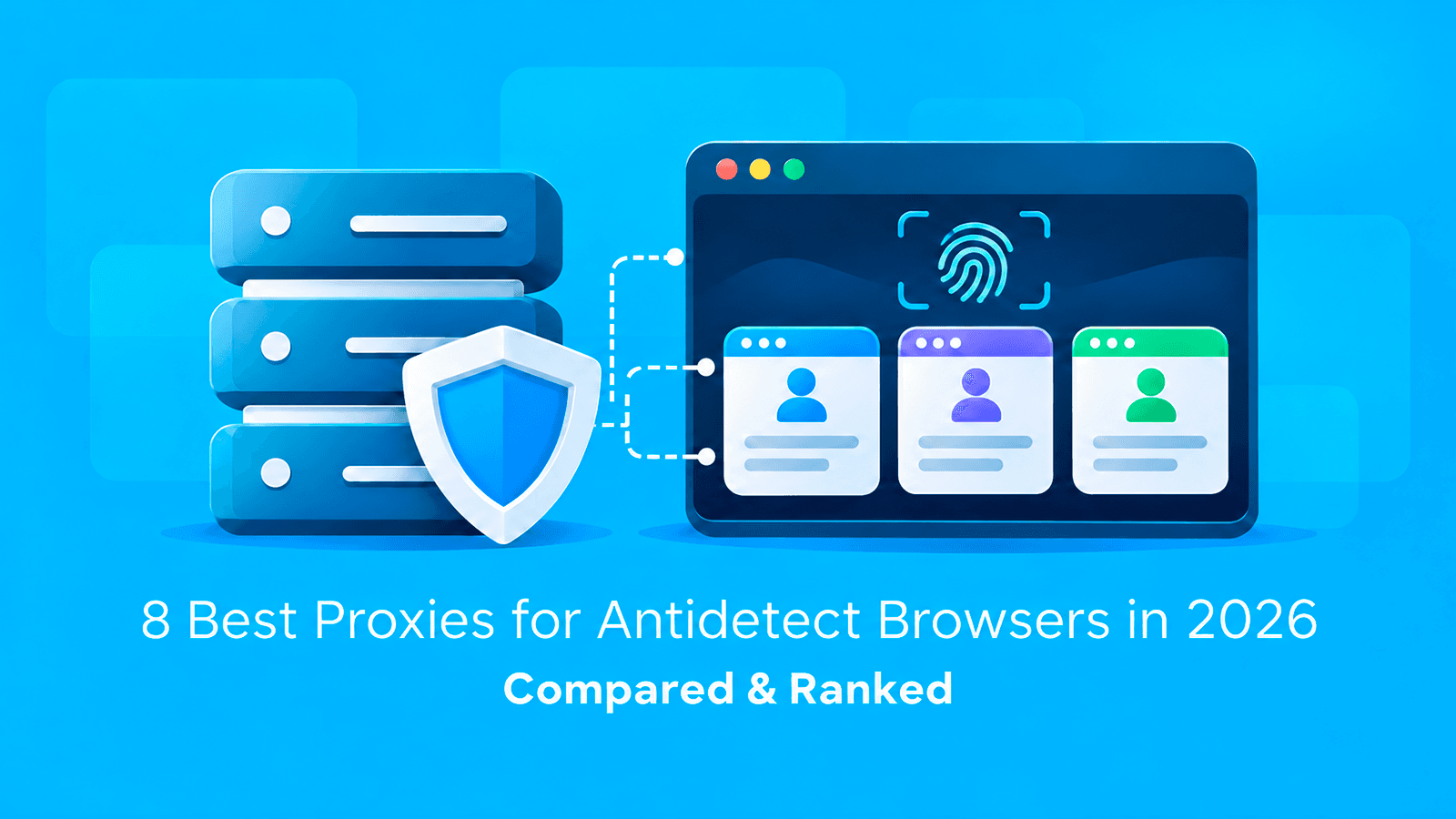
Proxies for antidetect browsers are network intermediaries that route each browser profile’s traffic through a selected IP address. The IP address helps determine the geographic location or network that websites detect. Antidetect browsers manage fingerprints, cookies, local storage, language, and time zone, while proxies handle the network connection. Together, they help businesses maintain separate network identities across multiple profiles.
This setup supports authorized multi-account management, regional advertising verification, marketplace research, and other workflows that require isolated browsing environments. For example, a business comparing eCommerce marketplaces in the US and UK can assign residential proxies from each country to separate profiles while keeping browsing data and sessions independent. Proxies do not guarantee anonymity or prevent account restrictions because websites may also evaluate browser behavior, fingerprints, and other signals.
Which Proxy Types Work Best With Antidetect Browsers?
The best option depends on the network and session needs of each profile. Residential proxies offer flexibility for regional research, mobile proxies support carrier-network testing, ISP proxies provide stable IPs, and datacenter proxies suit cost-conscious testing. Rotating and sticky sessions determine whether an IP changes between requests or stays the same for a set period.
- Residential proxies: Use IPs from residential internet connections, making them suitable for regional marketplace research, advertising verification, and profiles requiring consumer network addresses.
- Mobile proxies: Route traffic through mobile carrier networks, including 4G and 5G, supporting mobile-specific research, localized content checks, and carrier-based testing.
- ISP proxies: Provide relatively stable IP addresses associated with internet service providers, making them useful for persistent browser profiles and recurring authorized sessions.
- Datacenter proxies: Use IPs hosted in datacenter infrastructure, offering cost-effective connections for browser testing, automation development, and less location-sensitive tasks.
- Rotating proxies: Change IP addresses according to configured rotation rules, supporting independent research requests, large-scale data collection, and regional comparisons.
- Sticky proxies: Maintain the same IP for a defined period, supporting continuous browsing activities, connected workflows, and sessions requiring network consistency.
These categories can overlap, as residential and mobile proxies may also support rotating or sticky sessions. The right configuration depends on whether each browser profile requires long-term IP consistency or periodic rotation.
Why Is BitBrowser a Strong Choice for Proxy-Based Workflows?
BitBrowser is a strong choice for proxy-based workflows because it combines isolated browser profiles, fingerprint controls, and per-profile proxy configuration in one platform. Users can create profiles with separate cookies and local storage, then customize settings such as Canvas, WebGL, User-Agent, language, and timezone. These controls help businesses organize multiple online environments and manage each profile independently.
BitBrowser also supports HTTP, HTTPS, and SOCKS5 proxies, with options to assign a proxy to each profile and test connectivity before a session. API access, browser automation tools, and team collaboration features help businesses coordinate recurring tasks and manage profile access across projects.
BitBrowser and Live Proxies: A Powerful Combination
BitBrowser can also be paired with Live Proxies to combine isolated browser environments with residential and mobile proxy infrastructure. Live Proxies provide private IP allocation, country-, city-, and ASN-level targeting, and flexible session controls. Standard residential sticky sessions last up to 60 minutes, while mobile sessions support up to 30 minutes. Extended sticky sessions of up to 24 hours are available for eligible B2B deployments. Together, these capabilities support independent browser profiles with controlled network assignments, making the combination particularly useful for eCommerce research, regional advertising verification, authorized account management, and other workflows requiring consistent connections across multiple environments.
Further reading: How to Use BitBrowser with Live Proxies: Complete Setup Guide and Multi-Accounting With Lower Detection Risk: When You Need an Anti-Detect Browser and What It Allows You to Do?.
What Makes a Proxy Provider Suitable for Antidetect Browsers?
A proxy provider is suitable for antidetect browsers when it offers reliable connections, well-defined IP allocation, clear session and rotation controls, geographic targeting, compatible protocols, and transparent pricing. These features help teams configure network settings for each profile and manage recurring workflows consistently.
IP Quality and Private Allocation
IP quality affects whether websites recognize an address as residential, mobile, ISP, or datacenter infrastructure. It also influences connection reputation, although IP classification alone cannot predict how a particular website will respond. Private allocation can reduce the overlap between unrelated customers using the same IP resources. For businesses maintaining dedicated browser profiles, this offers greater control over network assignments and reduces dependence on widely shared proxy infrastructure.
Sticky Sessions and Rotation Control
Session persistence determines how long a browser profile can retain its assigned exit IP. This is particularly important for research sessions involving multiple connected pages, persistent environments, and authorized account operations. Providers should clearly document their session duration limits, rotation intervals, and behavior when a connection is interrupted. Rotating IPs are useful for independent tasks, while sticky or static connections are generally better suited to profiles that require continuity.
Geographic and ASN Targeting
Geographic targeting allows businesses to select proxy IPs from relevant markets. Country-level targeting may be sufficient for general research, while city-level targeting provides more precise results for local advertising, localized eCommerce listings, and regional search monitoring. ASN targeting adds another level of network selection by allowing users to work with IPs associated with particular autonomous systems. This can be useful when testing how websites behave across different network environments.
HTTP and SOCKS5 Compatibility
Antidetect browsers generally support HTTP, HTTPS, and SOCKS5 proxy configurations. HTTP-compatible proxy connections are commonly used for web browsing, while SOCKS5 provides a more general-purpose proxy transport option. Compatibility should be checked for the specific browser and proxy product. Authentication methods, DNS handling, and WebRTC behavior can also affect whether a configuration works as intended.
Connection Stability and Scalability
Browser profiles often load multiple pages and resources during a single session. Frequent proxy timeouts or connection failures can interrupt research and require repeated authentication or page loading. Businesses managing many profiles should evaluate connection reliability, concurrent session limits, bandwidth consumption, and provider support. Large IP pools are useful, but stable connections to the actual target websites are equally important.
Pricing and Bandwidth Options
Proxy pricing can be based on transferred data, the number of IP addresses, monthly subscriptions, or enterprise contracts. A low advertised price does not always translate into lower operating costs, especially when browser profiles load media-heavy pages. Teams should estimate bandwidth requirements, compare recurring charges, check whether unused traffic expires, and review trial or refund conditions before committing to a provider.
What Are the 8 Best Proxies for Antidetect Browsers in 2026?
The 8 proxy providers below are compared for antidetect browser use based on product flexibility, session management, network control, pricing, and support for independent profiles. This is an editorial ranking; the providers were not all benchmarked under identical conditions.
- Live Proxies: A strong option for enterprise-scale antidetect browser workflows requiring residential and mobile proxies, private target-level IP allocation, stable sessions, precise targeting, high concurrency, and dedicated B2B support.
- Oxylabs: Offers a large residential IP pool, advanced geographic targeting, and dedicated ISP options for enterprise teams managing multiple browser profiles.
- IPRoyal: Provides residential sticky sessions lasting up to seven days and ISP proxies for browser profiles requiring consistent IP addresses.
- Decodo: Combines flexible IP rotation, precise location targeting, and automation tools for managing browser profiles across different markets.
- SOAX: Supports detailed geographic and ASN targeting with configurable sessions for location-specific browser research and regional advertising checks.
- ProxyEmpire: Offers rotating and static residential IPs, flexible session settings, and traffic rollover for profiles with varying connection requirements.
- Webshare: Provides affordable rotating and static residential proxies, configurable bandwidth, and self-service management for smaller browser profile deployments.
- DataImpulse: Combines usage-based pricing, non-expiring residential traffic, and geographic targeting for browser profiles with variable bandwidth requirements.
Ranking Criteria
We evaluated the providers based on their suitability for antidetect browser workflows, focusing on available proxy types, session stability, geographic targeting, and browser integration and management tools. The comparison also considers each provider's ability to support persistent profiles, multi-profile operations, and location-specific tasks, alongside customer ratings from Trustpilot or G2.
Feature Comparison Table
The table below compares the proxy types, session controls, geographic targeting, and management tools available from each provider. These features help determine how well different services support persistent browser profiles, location-specific research, and multi-profile operations.
| Provider | Proxy Types | Session Control | Geo Targeting | Browser Integration & Management | Best Antidetect Browser Use Case | Rating |
|---|---|---|---|---|---|---|
| 1. Live Proxies | Rotating residential, rotating mobile | Rotating and sticky. Residential up to 60 min standard, up to 24h on eligible B2B configurations | Country, city, ASN | HTTP(S)/SOCKS5, dashboard, documented API, private target-level IP allocation | Enterprise multi-profile operations requiring private IP allocation and high concurrency | 4.0/5 Trustpilot |
| 2. Oxylabs | Residential, ISP, datacenter, mobile, dedicated ISP | Residential sticky up to 24h; mobile up to 30 min; static options on supported products | Residential: country, city, state, ZIP, coordinates, ASN | HTTP(S)/SOCKS5, endpoint generator, API and third-party integration guides | Enterprise profile management with advanced location and network selection | 4.0/5 Trustpilot |
| 3. IPRoyal | Residential, ISP, datacenter, mobile | Residential rotating or sticky from 1 sec to 7 days; static ISP options | Residential: country, state, city | HTTP(S)/SOCKS5, dashboard, proxy API, exportable endpoints | Persistent profiles requiring extended residential sessions or ISP IPs | 4.7/5 G2 |
| 4. Decodo | Residential, ISP, datacenter, mobile | Residential rotating or sticky up to 30 min on standard configurations; longer options vary | Residential: country, state, city, ZIP, ASN | HTTP(S)/SOCKS5, dashboard, endpoint generator, API and team tools | Automated multi-profile research with configurable proxy assignments | 4.2/5 Trustpilot |
| 5. SOAX | Residential, mobile | Per-request rotation and configurable sticky residential sessions | Residential: country, region, city, ASN | HTTP(S)/SOCKS5, dashboard and configurable proxy endpoints | Location-specific advertising checks and regional browser research | 3.4/5 Trustpilot |
| 6. ProxyEmpire | Rotating residential, unlimited residential, static residential, rotating mobile, dedicated mobile, rotating datacenter | Rotating per request, custom TTL up to 2h, or same IP until rotation/disconnection on rotating residential/mobile | Rotating residential: country, region, city, ZIP, ISP, ASN; varies by product | HTTP(S)/SOCKS5, Proxy Manager, session IDs, generated proxy lists | Profiles requiring flexible residential sessions and detailed location selection | 4.6/5 Trustpilot |
| 7. Webshare | Rotating residential, static residential, private static residential, dedicated static residential, datacenter | Rotating per request or sticky for 1 min–24h on rotating residential; static IP options | Rotating residential: country, state, city, ZIP, ASN | HTTP/SOCKS5, endpoint generator, dashboard, proxy-list API | Cost-conscious profile setups with configurable sessions and static IP options | 4.0/5 Trustpilot |
| 8. DataImpulse | Residential, mobile, datacenter | Rotating and sticky; residential sticky duration depends on product configuration | Country included; state, city, ZIP, ASN options | HTTP(S)/SOCKS5, dashboard and configurable proxy endpoints | Variable-bandwidth profile research with usage-based traffic purchasing | 4.7/5 G2 |
Pricing Snapshot
Pricing structures vary by provider, with differences in traffic allowances, IP-based billing, enterprise commitments, and trial conditions. The table below compares B2C entry prices, enterprise options, and refund policies to help evaluate costs for different antidetect browser workloads.
| Provider | Pricing Model | B2C Entry Price | Enterprise Price | Trial / Refund |
|---|---|---|---|---|
| 1. Live Proxies | Plan-based / usage-based | Rotating residential and mobile proxies start at $70 for 4GB with 30-day validity. Residential plans include 200 IPs, while mobile plans include 50 IPs | Enterprise pricing starts at 2,000/month for 1TB (2/GB). Custom B2B volume pricing depends on traffic volume, targeting needs, and deployment scale. | Free trial available for eligible B2B customers. Refunds are generally unavailable. An unused accidental purchase of the wrong product may qualify for a refund if requested within 3 days |
| 2. Oxylabs | Traffic-based / per-IP | Residential proxies start at $6/GB ($30 for 5GB/month). Mobile proxies start at $7.50/GB ($30 for 4GB/month) | Corporate Residential starts at $2,500/month for 1TB ($2.50/GB). Corporate Mobile starts at $2,500/month for approximately 715GB ($3.50/GB) | Eligible verified businesses may qualify for a 7-day free trial. Refund requests must be submitted within 3 days and meet applicable usage and policy conditions |
| 3. IPRoyal | Traffic-based / per-IP | Residential proxies start at $7/GB with Subscription or $7.35/GB PAYG. ISP proxies start at $1.80/IP on eligible plans | Residential enterprise pricing starts at $1.75/GB on Subscription or $1.84/GB PAYG for 10TB+. Custom enterprise arrangements are available | Free trials may be available to eligible verified businesses. Refunds are conditional, including qualifying technical issues or accidental subscription renewals |
| 4. Decodo | Traffic-based / per-IP | Residential proxies start at $3.75/GB on a 3GB plan or $4/GB PAYG. Mobile proxies start at a promotional $3.75/GB on a 2GB plan. Datacenter proxies start at $0.60/GB, while ISP pricing depends on the selected package | Residential Enterprise starts at $625/month for 250GB ($2.50/GB). The 1TB plan costs $2,000/month ($2/GB), with custom options available. VAT may apply | Eligible products offer a 3-day free trial with 100MB. Qualifying purchases may be refunded within 14 days, subject to usage, payment, and other policy conditions |
| 5. SOAX | Subscription / credit-based | Free Sandbox without network credits. Builder costs $200/month + VAT for 200 credits, and Team costs $500/month + VAT for 500 credits. Builder network rates range from $1.20 to $3/GB depending on geographic tier | Enterprise starts at $3,000/month + VAT with 3,000 credits. Network rates range from $0.35 to $0.85/GB depending on geographic tier | Free Sandbox plan available without included proxy traffic. Payments are generally non-refundable, subject to qualifying exceptions |
| 6. ProxyEmpire | Traffic-based / per-IP | Rotating Residential PAYG costs $7/GB, currently discounted to $3.50/GB. The promotional Starter plan costs $20 for 7GB ($2.85/GB). Rotating Mobile starts at a promotional $4.50/GB, Rotating Datacenter at $25/month for 40GB, and Static Residential at $3.50/IP/month | Promotional Rotating Residential Enterprise pricing starts at $1,500 for 1,000GB ($1.50/GB). Custom plans for 5TB+ are advertised from $0.75/GB | Paid trial available for $1.97. Purchases are generally final, with refunds granted at the provider’s discretion under qualifying circumstances |
| 7. Webshare | Subscription-based | Rotating Residential proxies start at $3.50 for 1GB/month. Static Residential proxies start at $6/month for 20 IPs ($0.30/IP) | Custom enterprise plans are available based on traffic volume and infrastructure requirements. Published Rotating Residential pricing reaches $1.40/GB for 3,000GB/month ($4,200/month) | Free plan includes 10 proxy servers and 1GB of monthly bandwidth. Qualifying refund requests must be submitted within 48 hours and meet product-specific usage limits |
| 8. DataImpulse | Traffic-based / PAYG | Residential proxies start at $1/GB, with a $5 introductory package for 5GB. Premium Residential starts at $5/GB. Residential volume pricing reaches $0.80/GB on the 1TB package | Custom plans are advertised from $4,000 for Residential and Premium Residential, $2,250 for Datacenter, and $8,000 for Mobile on qualifying larger-volume commitments | A $5 introductory package is available. Corporate-email users may qualify for free test traffic. An advertised 7-day refund policy applies subject to the provider’s conditions |
1. Live Proxies

Live Proxies is a California-based proxy provider founded in 2020. It offers rotating residential and mobile proxies backed by millions of IP addresses across 176 locations worldwide, with particularly strong coverage in the US, UK, and Canada. Its infrastructure focuses on private IP allocation on supported plans, configurable session behavior, location targeting, and support for businesses managing recurring proxy workloads.
For antidetect browsers, Live Proxies is particularly relevant when separate profiles require controlled IP assignments and predictable connections. The platform combines HTTP/HTTPS compatibility with SOCKS5 and country-, city-, and ASN-level targeting on supported configurations, plus unlimited concurrent threads. Standard residential sticky sessions last up to 60 minutes. Extended sticky sessions of up to 24 hours are available for eligible B2B deployments, supporting longer workflows that require consistent IP access.
Key Advantages
- Private IP allocation: Target-level allocation helps reduce IP overlap with unrelated customers accessing the same websites, supporting more controlled browser profile environments.
- Flexible sticky sessions: Standard residential sessions last up to 60 minutes, and extended sessions last up to 24 hours for eligible B2B deployments.
- Precise location targeting: Country, city, and ASN controls allow teams to assign browser profiles to relevant geographic and network environments.
- Residential and mobile coverage: Access to both network categories supports regional eCommerce research, mobile experience testing, advertising checks, and related workflows.
- HTTP/HTTPS and SOCKS5 compatibility: Both protocols support integration with antidetect browsers that allow custom authenticated proxy connections.
- Unlimited concurrent threads: The infrastructure supports high-concurrency workloads, although actual browser capacity also depends on local hardware, bandwidth, and service limits.
Potential Limitations
- Limited free trial availability: Free trials are primarily available to eligible enterprise customers, with fewer evaluation options for individual users and smaller teams.
- Limited product diversity: The core rotating residential and mobile offering is narrower than competitors that also provide dedicated ISP and datacenter products.
2. Oxylabs

Oxylabs offers residential, ISP, mobile, and datacenter proxies for businesses managing large-scale online operations. Its residential network includes over 175 million IPs across 195 countries, with geographic targeting at the country, state, city, ZIP code, coordinate, and ASN levels. The provider also advertises a 99.95% average success rate and approximately 0.4-second response times for its residential proxies.
For antidetect browsers, Oxylabs supports both rotating and sticky sessions, HTTP(S) and SOCKS5 protocols, and unlimited concurrent residential proxy sessions. These capabilities suit organizations managing numerous browser profiles across different locations, while dedicated ISP and datacenter options offer alternatives for environments requiring more persistent IP assignments.
Key Advantages
- Broad proxy selection: Residential, mobile, ISP, and datacenter options allow organizations to choose infrastructure according to individual profile requirements.
- Enterprise-scale infrastructure: Large proxy networks and high-concurrency support make the service relevant to organizations operating numerous research environments.
- Detailed geographic targeting: Location and network-level controls support international marketplace research and regional advertising verification.
- Dedicated IP options: ISP and dedicated datacenter products can support applications that need consistent network addresses rather than frequent rotation.
- Technical integration resources: Documentation and enterprise support are useful for teams connecting proxies to managed browser environments and automation systems.
Potential Limitations
- Higher enterprise spending: Large residential and mobile proxy commitments can require substantial monthly budgets.
- Complex product selection: Multiple proxy categories and pricing models may require additional evaluation before choosing a configuration for individual browser profiles.
- Session differences: Rotation behavior and connection features vary across products, so a setup suitable for one proxy category may not apply to another.
3. IPRoyal

IPRoyal provides residential, ISP, datacenter, and mobile proxies, with a residential network of over 64 million IPs across 195+ countries. Its residential service supports HTTP(S) and SOCKS5 connections, country-, state-, and city-level targeting, and an advertised 99.4% success rate with approximately 0.5-second response times.
For antidetect browser profiles, IPRoyal offers configurable rotation and sticky sessions lasting from one second to seven days. Users can choose a new IP for each request or retain one address for connected browsing activities. Combined with its ISP proxy products, these options make the service suitable for both temporary research environments and recurring authorized sessions.
Key Advantages
- Multiple proxy categories: Users can choose residential, ISP, datacenter, or mobile IPs depending on the intended browser environment.
- Extended residential persistence: Supported residential configurations allow long sticky sessions, including options lasting up to seven days.
- Flexible purchasing: Residential traffic options and IP-based products make it possible to match spending to the required connection model.
- Browser-compatible protocols: HTTP(S) and SOCKS5 support allows configuration in antidetect browsers that accept authenticated proxy connections.
- Accessible self-service setup: Proxy management tools make the platform practical for smaller teams building and maintaining individual browser profiles.
Potential Limitations
- Product-specific capabilities: Session behavior, targeting precision, and billing rules differ between residential, ISP, mobile, and datacenter packages.
- Cost variation: Longer-term dedicated IP arrangements may not be the most economical choice for short, independent research sessions.
4. Decodo

Decodo, formerly Smartproxy, provides residential, ISP, mobile, and datacenter proxies alongside web data collection tools. Its residential network contains over 115 million IPs across 195+ locations, with targeting by country, state, city, ZIP code, and ASN. The provider reports a 99.92% residential proxy success rate, response times below 0.5 seconds, and 99.99% uptime.
For antidetect browsers, Decodo supports HTTP(S) and SOCKS5 connections with rotating and sticky residential sessions. Its dashboard includes live usage statistics, spending analytics, and team management features, helping businesses organize proxy resources across multiple browser profiles and monitor traffic consumption during ongoing research.
Key Advantages
- Multiple connection types: Residential, ISP, mobile, and datacenter proxies support different browser profile requirements within one provider.
- Flexible session options: Rotating and sticky configurations allow users to choose between independent requests and connected browsing sessions.
- Detailed targeting: Residential products support country, state, city, ZIP code, and ASN selection for localized online research.
- Competitive residential pricing: Smaller residential packages provide an accessible starting point for testing profile-level proxy configurations.
- Automation-friendly infrastructure: Integration documentation and complementary data tools make the service relevant to teams combining manual browser access with authorized automation.
Potential Limitations
- Different controls across products: Targeting and session capabilities may not be identical for every proxy category.
- Bandwidth-dependent spending: Large numbers of image-heavy browser profiles can increase residential traffic costs.
- More infrastructure than some users need: Smaller projects focused on a handful of persistent profiles may not require the broader automation ecosystem.
5. SOAX

SOAX provides residential and mobile proxy infrastructure for location-specific research and data collection. Its residential network includes more than 155 million IPs across 195+ geographic locations, while its mobile offering covers approximately 33 million IPs associated with cellular networks. SOAX advertises a 99.95% residential proxy success rate and response times of approximately 0.55 seconds.
For antidetect browsers, SOAX supports HTTP(S) and SOCKS5 connections, configurable sticky sessions, and rotation on individual requests. Users can target residential IPs by country, region, city, or ASN, allowing businesses to organize browser profiles around specific markets and maintain consistent connections during longer regional research activities.
Key Advantages
- Detailed location targeting: Country, region, city, and ISP-level selection supports browser profiles configured for specific geographic markets.
- Residential and mobile networks: Teams can choose between consumer internet connections and cellular network IPs according to the research objective.
- Configurable session behavior: Rotation and sticky session options help align proxy behavior with individual browser tasks.
- Network-oriented research: Targeting capabilities make the service suitable for comparing advertising, search results, and localized website content.
- Scalable business packages: Higher-tier options are available for organizations requiring additional bandwidth and operational support.
Potential Limitations
- Higher monthly commitment: Subscription-oriented pricing may be less convenient for users with occasional or unpredictable browser activity.
- Session continuity considerations: Available IPs and connection persistence can depend on the selected network and configuration.
- Less emphasis on dedicated static products: Users primarily seeking long-term fixed ISP addresses may prefer a provider with a broader dedicated IP portfolio.
6. ProxyEmpire

ProxyEmpire offers rotating and static residential proxies, rotating and dedicated mobile proxies, unlimited residential plans, and datacenter connections. Its rotating residential network includes more than 30 million IPs across 170+ countries, with country, region, city, and ISP targeting. The provider advertises 99.9% uptime and supports HTTP, HTTPS, HTTP/2, and SOCKS5 protocols.
For antidetect browsers, ProxyEmpire provides flexible rotation controls, including a new IP per request, custom intervals of up to two hours, and sticky sessions without a fixed maximum duration. Sticky IPs remain available until manually rotated or the underlying device disconnects. Static residential proxies offer another option for profiles requiring longer-term IP consistency.
Key Advantages
- Flexible residential products: Rotating and static residential options support different browser profile lifecycles.
- Multiple mobile options: Rotating and dedicated mobile proxy offerings provide alternatives for mobile network research.
- Session management: Sticky and rotating configurations help businesses select appropriate IP behavior for separate tasks.
- Traffic rollover options: Eligible packages allow unused bandwidth to carry forward, which can benefit workloads with changing monthly demand.
- Broad location availability: Country and more detailed location selection support international browser research projects.
Potential Limitations
- Varied pricing structures: Different proxy categories and bandwidth packages require careful comparison before deployment.
- Feature differences by product: Session length, static assignment, and targeting options depend on the selected proxy type.
- Additional planning for persistent profiles: Businesses need to distinguish static products from rotating packages with temporary sticky sessions.
7. Webshare

Webshare offers rotating residential, static residential, and datacenter proxy solutions with self-service configuration options. Its residential network provides access to over 80 million IPs across 195 countries, including more than 6.6 million US IPs and 1.5 million UK IPs. The provider advertises 99.97% uptime for its residential network and supports targeting by country, state, city, ZIP code, and ASN.
For antidetect browsers, Webshare supports HTTP and SOCKS5 connections, with rotating residential proxies and static residential options for profiles requiring different levels of IP persistence. Users can configure proxy counts, bandwidth, and locations through the dashboard, while the limited free plan provides 10 proxy servers for initial connectivity testing.
Key Advantages
- Accessible entry pricing: Small residential packages make it easier to evaluate proxy behavior before expanding a deployment.
- Static residential options: Different static proxy products provide alternatives for profiles needing persistent IP assignments.
- Straightforward management: Dashboard tools and proxy configuration options support individual browser profile setup.
- HTTP and SOCKS5 availability: Common proxy protocols allow integration with antidetect browsers supporting custom network settings.
- Free entry option: A limited free proxy server plan can be useful for basic connectivity checks and initial technical evaluation.
Potential Limitations
- Different network characteristics: Static residential, rotating residential, and proxy server products vary in allocation, billing, and connection behavior.
- Limited free-plan suitability: Free proxy resources are not a substitute for testing production-grade residential session performance.
- Plan-dependent controls: Advanced management, traffic limits, and location options may require higher-tier packages.
8. DataImpulse

DataImpulse provides residential, mobile, and datacenter proxies with usage-based pricing and flexible traffic allocation. Its residential network includes more than 90 million IPs across 195 countries, with country, state, city, ZIP code, and ASN targeting. Residential traffic starts at $1/GB, and purchased bandwidth does not expire, allowing users to manage consumption without recurring traffic deadlines.
For antidetect browsers, DataImpulse supports HTTP(S) and SOCKS5 connections alongside rotating and sticky residential sessions. Its location targeting and pay-as-you-go model suit businesses operating browser profiles with irregular activity, particularly when regional research tasks require different amounts of traffic from one month to another.
Key Advantages
- Low residential entry price: Usage-based pricing starting at $1/GB can make initial proxy testing relatively affordable.
- Multiple network categories: Residential, mobile, and datacenter proxies provide options for different browser-based research requirements.
- Rotating and sticky configurations: Session controls support both independent browsing tasks and activities requiring temporary IP continuity.
- Geographic targeting: Location selection helps assign browser profiles to relevant markets for regional research.
- Flexible traffic purchasing: A bandwidth-oriented model can suit businesses with changing or irregular proxy consumption.
Potential Limitations
- Variable traffic consumption: Media-heavy browser sessions can use bandwidth quickly, even when the advertised per-GB rate is low.
- Product-specific persistence: Sticky residential sessions do not provide the same guarantees as permanently assigned static IPs.
Further reading: What Are Private Proxies and How Do They Work? Pros and Cons and How to Test Live Proxies IPs with ToDetect: A Complete Guide.
How Are Proxies Used With Antidetect Browsers?
Proxies are used with antidetect browsers by routing each profile’s traffic through an assigned proxy IP address. This gives profiles separate network connections while the browser keeps their cookies and browsing data isolated. Businesses use this setup for multi-account management, regional market research, ad verification, SEO monitoring, automation, and team workflows.
Multi-Account Management
Businesses managing multiple authorized accounts can assign separate proxy connections to individual browser profiles. This helps maintain independent browsing environments, preserve session continuity, and organize account-related activities across different platforms. Sticky or static proxies are particularly useful when accounts require consistent IP addresses across recurring sessions. Teams can also assign specific profiles and proxy configurations to individual projects for easier management.
eCommerce and Market Research
Residential and mobile proxies allow researchers to access marketplaces from different geographic locations and compare regional product listings, prices, and availability. Separate browser profiles help keep research sessions organized without mixing cookies or browsing histories. Location targeting also supports more accurate comparisons of localized promotions, shipping options, and competitor offerings. Teams can revisit the same markets using consistent network settings to track changes over time.
Ad Verification and SEO Monitoring
Location-targeted proxies support regional advertising checks, localized search result monitoring, and competitor visibility analysis. Combined with antidetect browsers, they allow teams to maintain distinct research environments for different markets and campaigns. This makes it easier to compare how ads, landing pages, and search results appear across geographic locations. Consistent proxy assignments also help teams conduct repeated checks under comparable network conditions.
Browser Automation
Proxy-enabled browser profiles can support repetitive tasks such as public data collection, website testing, and content monitoring. Sticky sessions maintain IP consistency during connected operations, while rotating proxies are useful for independent research requests. When combined with supported automation tools, separate profiles can run structured workflows without sharing browser storage or network configurations. This is particularly valuable for businesses processing recurring research tasks across multiple markets.
Team-Based Workflows
Teams can organize browser profiles by project, client, or geographic market while assigning appropriate proxy connections to each environment. This supports clearer separation of browsing activities, more consistent network configurations, and easier management of recurring tasks. Shared profile management and role-based permissions can help coordinate access among authorized team members. Standardized proxy settings also make it easier to maintain consistent workflows when responsibilities change.
What Should You Look for in an Antidetect Browser?
Look for an antidetect browser with configurable fingerprint settings, isolated profiles, per-profile proxy support, automation tools, team controls, and straightforward profile management. The points below explain what each capability contributes to everyday workflows.
- Browser Fingerprint Management: Look for configurable browser parameters, including User-Agent, WebGL, Canvas, language, and timezone, to support consistent profile environments.
- Profile Isolation: Each profile should maintain separate cookies, local storage, cache, and browsing sessions to prevent data from being mixed between environments.
- Proxy Compatibility: Support for HTTP, HTTPS, and SOCKS5 connections allows users to work with different proxy providers and configure network access for individual profiles.
- Automation Capabilities: API access and browser automation tools can simplify repetitive operations, profile creation, and ongoing management of larger workflows.
- Team Collaboration: Shared profile management, permission controls, and workspace organization help teams coordinate activities without unnecessarily sharing account credentials.
- Ease of Use: A clear interface, convenient proxy configuration, and straightforward profile management reduce setup time and make everyday operations easier.
The most suitable option should balance these capabilities with reliable performance, transparent pricing, and the ability to support the number of profiles required by the business.
What Are the Benefits of Using Antidetect Browsers With Proxies?
The main benefits are separate browser and network identities, more consistent sessions, access to region-specific content, and easier management of research and team workflows. Antidetect browsers manage profile settings and session data, while proxies route each profile’s traffic through an assigned IP address.
Separate Browser Profiles and Network Identities
Assigning different proxy connections to individual profiles keeps network settings, cookies, local storage, and browsing sessions organized across projects and authorized accounts. This reduces accidental overlap between independent environments.
Maintain Consistent Sessions
Sticky or static proxies can keep the same IP address assigned to a profile during recurring browsing activities. Combined with isolated profile data, this supports workflows that rely on session continuity.
Access Regional Content and Compare Results
Location-targeted proxies let teams view websites, ads, search results, and marketplace listings from relevant markets. Reusing comparable browser and network settings can also make it easier to track changes in regional content over time.
Organize and Scale Team Workflows
Teams can manage multiple profiles with separate network configurations for parallel research, automation, and recurring tasks. Shared profile management and assigned settings can help coordinate work across projects and team members.
Conclusion
Choosing the right proxy provider for antidetect browsers depends on the scale of operations, session requirements, and the level of control needed over individual browser profiles. Live Proxies is a strong option for enterprise clients managing large-scale antidetect browser workflows, particularly those requiring private IP allocation, stable sessions, and dedicated B2B support. Oxylabs offers extensive infrastructure for enterprise operations, while IPRoyal provides flexible options for maintaining persistent browser profiles.
Other providers address different priorities. Decodo offers useful automation capabilities, SOAX focuses on precise geographic targeting, and Webshare provides more affordable options for smaller deployments. Ultimately, the best choice depends on matching each provider's strengths with the specific requirements, operational scale, and budget of the intended browser workflows.