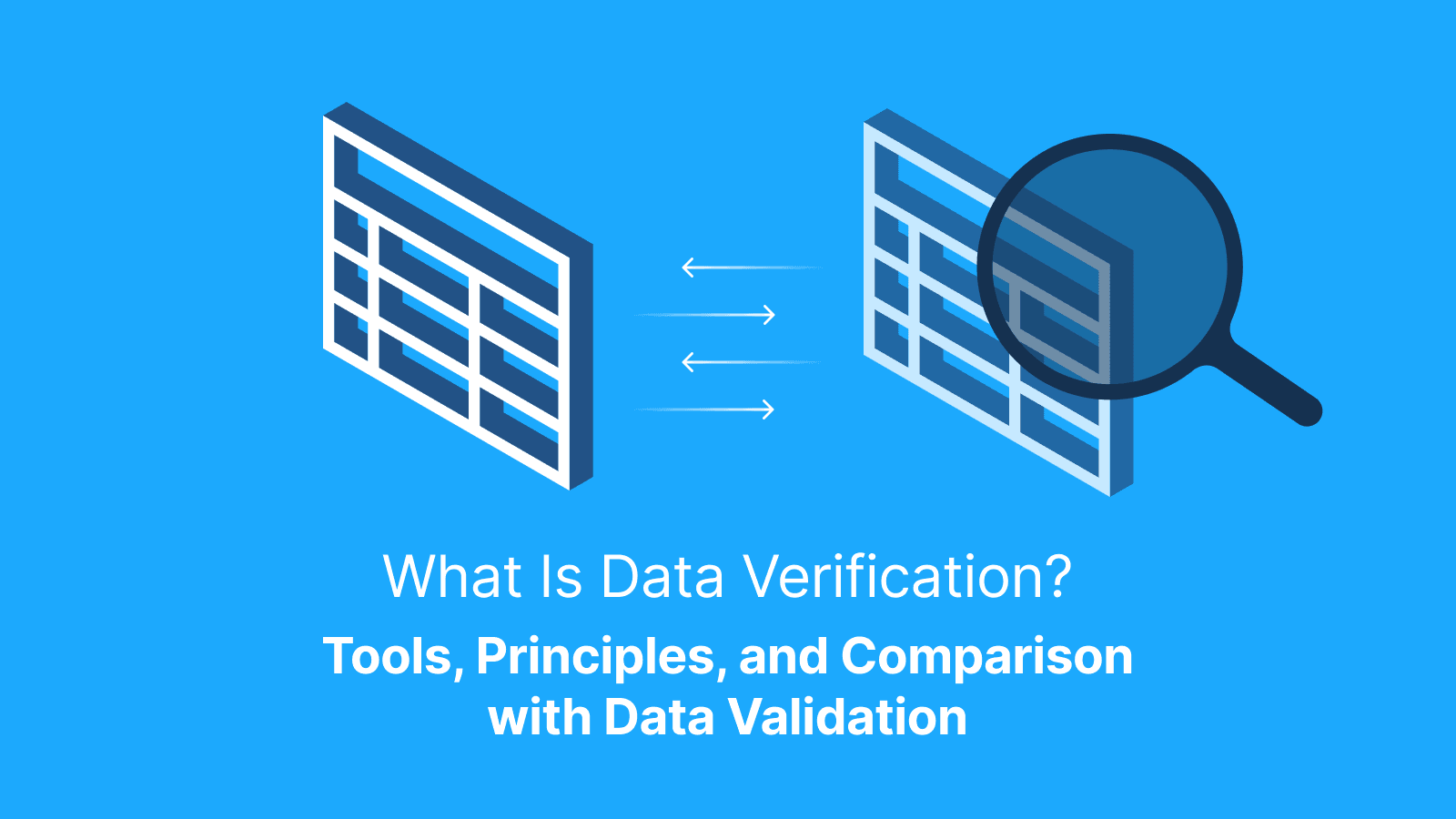

Data verification is a quality process that checks data for accuracy, completeness, and consistency against trusted rules or sources.
This comprehensive guide clarifies data verification versus data validation, walks through a simple lifecycle, details methods for identity and source data verification, explains API based verification, outlines essential tools, and shows where proxies help verify public web facts. The guide anchors the tone for beginners while retaining depth and concludes with a printable checklist.
What is data verification?
Data verification is the process of confirming that stored or received data is accurate, complete, and consistent by comparing it with rules or authoritative references. It acts as a necessary quality check to ensure the information reflects real-world facts.
Data verification is especially useful during various data lifecycles, like:
- Importation: Verifying new records before they enter the system.
- Migration: Ensuring data remains intact during transfers between systems.
- Merging: Confirming consistency when combining multiple datasets.
- Periodic Quality Sweep: Running regular checks for data hygiene.
Simple Example: Verifying a customer's ZIP code by cross-checking it against an official postal reference database to confirm the ZIP code exists and maps to the stated city. Another check is comparing the number of records in a source database and the target system after a migration to confirm completeness and integrity.
Data verification is often confused with data validation. Verification checks data against authoritative references (internal or external) to confirm it matches a trusted record. Validation checks that data meets defined rules and constraints (format, ranges, allowed values, and cross-field logic). We will make a thorough comparison below.
Verification goals
Data verification aims to achieve some goals that are directly tied to some measurable KPIs, including:
- Identifying inaccuracies and eliminating errors. Teams usually measure this by achieving a set low error threshold.
- Ensuring data is not corrupted, lost, or duplicated during movement. A major KPI for measuring this goal is ensuring that there is minimal reconciliation time after system migration.
- Ensuring data used for business models is reliable. You can determine this goal’s success through reduced data quality incidents and increased stakeholders’ satisfaction.
- Reducing the risks of bad data flowing into the operational system. The success of this goal is evident in reduced downstream rework.
Typical triggers
Several incidents can trigger data verification, and they can be planned or spontaneous. Instances when teams run verifications include:
- After a System Migration: Thorough checks immediately performed following the transfer of data to a new platform to ensure all data arrived successfully.
- Before Publishing Regulatory Reports: Finance, audit, and compliance teams must verify reported values match transactional systems before public or regulatory submission.
- After Vendor Data Loads: Checking data received from external vendors (e.g., product catalogs, risk scores) to ensure it matches the expected volume, structure, and reference values.
- During Contractual SLAs: To prove adherence to contractual accuracy or completeness levels for daily or hourly data feeds.
- When Anomalies Spike: When unusual patterns (e.g., unexplainable values, sudden drops in revenue) prompt an immediate verification sweep to ascertain possible causes.
Data verification vs data validation: what’s the difference?
Data verification and data validation are complementary but distinct data quality practices. Validation is a gatekeeping function that occurs at the entry point to ensure data meets the defined format and allowed rules. Verification can run at ingestion and after storage or movement, depending on risk, cross-referencing it against external authoritative sources and matching business reality.
A comparative example is that while validation may confirm that the shipment date is in a YYYY-MM-DD format, verification compares that the date tallies with the one on the shipment log. Therefore, high-quality teams combine both practices to ensure data remains reliable.
Timing and purpose
Data validation occurs before or at the ingestion point, while verification can run at ingestion, after storage, or after movement, depending on the workflow and risk.
The purpose of data validation is to prevent wrong input, while verification ensures data integrity. Validation answers the question: “Does the data meet required rules?” For verification, the question it answers is: “Does the data match reality or a trusted reference?”
Examples that stick
The table below provides concrete examples that show the difference between validation and verification when compared on the same fields:
| Feild | Validation | Verification |
|---|---|---|
| Email data | Checks if the address fits a regex | Use an email verification service that checks deliverability signals and, where supported, limited SMTP checks to estimate whether an address can receive mail |
| Product Code | Ensures the code follows the required pattern and contains the right number of characters | Checks the existence of the code in a master reference catalogue |
| File Ingestion | Confirms incoming file matches expected schema, column order, and file type | Reconciles the record count with source totals or ledger entries to prevent missing or duplicated files |
How does data verification work (lifecycle)?
Data verification follows a structured, repeatable six-step lifecycle that promotes transparency and an auditable record of data quality.
- Define Acceptance Criteria: List the criteria for "good data," connecting them to business targets. Data Owners define the criteria; Data Engineers translate them into technical rules.
- Choose Reference Sources: Identify the authoritative sources (internal master systems, official ledgers, or external third-party APIs) to check the data against.
- Select Verification Methods: Determine the appropriate techniques based on context, ranging from simple internal SQL lookups to complex external API calls.
- Execute Checks at Field and Record Level: Run the verification methods. Field-level checks identify individual attribute issues, and record-level checks analyze broader anomalies.
- Reconcile and Remediate: When a check fails, diagnose the root cause by reconciling the discrepancy (comparing counts/totals) and applying documented fixes to build repeatable playbooks.
- Publish an Audit Log and Schedule Recurrence: Produce an audit log detailing the verification process for the Compliance team and schedule a recurring verification process to ensure consistent data quality.
Field-level checks
These checks focus on individual attributes and their relationships within a record, resulting in a clear pass/fail outcome:
- Referential Integrity: Field values like customer ID exist in the master table.
- Domain Lists/Ranges: Field value, like transaction status, is an acceptable value
- Uniqueness: Flagging duplicates in identifiers like SSN
- Cross-Field Logic: Verifying relationships between fields (e.g., if DiscountApplied is "Yes," then DiscountPercentage must be greater than 0%).
Record- and set-level checks
Record level seeks to identify broader anomalies or systemic issues. Examples are:
- Duplicates: Identifying fuzzy matching in records where they are logically the same but with different keys.
- Outlier Detection: Flagging records that do not match patterns or statistical values.
- Aggregates to Controls: Comparing the sum of numerical fields against known trusted values.
- Sample-Based Manual Reviews: Manually reviewing a small/representative sample of sensitive data.
Reconciliation and remediation
Verification ends with reconciliations that compare counts, totals, or hash values between source and target systems. Discrepancies generate tickets with clear evidence, root-cause notes, and documented fixes. This forms a repeatable playbook for preventing recurrence.
Further reading: What Is Data Parsing: Benefits, Tools, and How It Works and What is Web Scraping and How to Use It in 2025?.
What is source data verification (SDV)?
Source data verification involves confirming that the data in the target system accurately matches the source system. It hinges on being able to trace data to its origin. Therefore, it is a critical process in highly-regulated industries.
Such settings include clinical trials where the team ensures that the data entered into the electronic Case Report Form tallies with the original documentation, like lab reports. Similarly, in accounting and financing, SDV involves reconciling the electronic ledger with the transaction files.
With SDV, teams aim for a verifiable link from the original evidence/record to the final report.
Sampling vs 100% checks
Teams perform SDV by sampling or checking in-depth for 100% verification, depending on the industry’s regulations. In clinical trials, SDV depth is typically risk-based. Some teams verify critical data more deeply, while others use targeted or adaptive sampling depending on the protocol and risk.
Sampling is more cost and time-efficient, and suitable for low-risk, large datasets. The most common is adaptive sampling, where the initial sampling’s error rates can lead to full verification or an increase to a larger proportion.
Evidence trail
Evidence trail gives internal and external audit teams the link back to the original data. Therefore, it is the backbone of source data verification. Key components of evidence trails are:
- Source snapshots: Keeping the original copy of the source data image
- Hash Files: Generating and storing a cryptographic hash that changes when tampered with
- Timestamps: Documenting the exact time and date of the verification cycle
- Attribution: Preserving data about the user, systems, and time of verification
How is data source verification achieved via API?
API data verification is a more thorough process, involving confirming data in real-time using the service of external reference providers or first-party endpoints. This is beyond internal checks and involves external trusted sources for robust data verification. Examples include address standardization APIs, phone and email verification services, and company registry lookups.
You can follow this minimal pattern for engaging API data verification:
- Prepare the data in a consistent required format
- Implement an API retry mechanism for temporary failures
- Validate API response structure to avoid silent or partial failure
- Store successful verification results for a defined period (Time-To-Live or TTL)
Proper API verification ensures reduced cost, speeds up subsequent checks, and prevents unnecessary calls for stable data.
API selection checklist
To choose the right API for verifying your dataset, there are some things you should check. The list below can guide you.
- Coverage: Does the API cover the necessary geographical regions or data domains?
- Freshness: How often is the reference data updated by the provider?
- SLA (Service Level Agreement): What uptime and latency are guaranteed by the provider?
- Cost Per Call and Quota Limits: Understanding the pricing model and ensuring it aligns with your expected volume.
- Licensing: What are the restrictions on how the verified data can be used or stored?
- PII Handling: Ensuring the provider's security and privacy practices comply with your internal policies regarding Personally Identifiable Information.
To avoid diving in headfirst, you can first test the API with a small golden dataset.
Reliability patterns
External APIs are prone to network issues and can fail. So, you must be prepared for other solutions when that happens. Options include circuit breakers, idempotent retries, cache-aside, and fallbacks to manual review, when that happens.
Identity data verification: what matters?
Identity verification involves confirming that a person is real, currently exists, and that a person or an entity matches submitted attributes. This is essential in KYCs and AML procedures. Core identity verification methods include document checks, liveness checks, KYC watchlists, and knowledge-based factors. Identity verification must have a lawful basis, be transparent, and minimize data collected. Identity verification typically relies on legal obligation or contractual necessity; consent may apply only in limited, valid contexts.
Match rules
When comparing submitted identity data against a reference source, the rules for determining a match must be carefully tuned. There is strict matching used for high-risk situations, which gives room for no error whatsoever. Fuzzy matching, on the other hand, allows for minor deviation as it is used for low-risk processes.
False positives and bias
Identity verification systems can have false positives due to demographic and language bias. So, it is essential to add a human-in-the-loop for a more thorough check and continuous re-scoring to keep the system up to standard.
What tools and data verification services exist?
Data verification capabilities are provided by tools and services that fall into distinct categories:
| Tool Category | When to use it | Expected outputs | Typical owners |
|---|---|---|---|
| Data Quality Platforms | For enterprise-wide data governance, complex rule creation, and data transformations. | Rule engines, lineage maps, transformation scripts, and reports on data quality over time. | Data Governance Office, Data Stewards. |
| ELT-Integrated Checkers | For checks directly inside data pipelines (e.g., Fivetran, dbt, or Spark scripts). | Pass/fail status on batch loads, automatic quarantining of bad records, and immediate pipeline alerts. | Data Engineers, Analytics Engineers. |
| Reconciliation Dashboards | For checking aggregates, counts, and sums across different systems (e.g., Finance vs. CRM). | Visual variance reports, drill-down capabilities, and automatic alerts when totals don't match. | Finance, Operations, and Data Auditors. |
| API Verifiers (Email/Phone/Address) | For near real-time, high-volume confirmation of contact data against external authoritative sources. | Boolean pass/fail, normalized data, risk scores, and deliverability status. | Marketing, Sales, Customer Support. |
| KYC/AML Suites | For verifying identity and screening against watchlists as part of regulatory compliance. | Identity match scores, risk flags, sanction hits, and comprehensive audit trails. | Compliance, Legal, Fraud Operations. |
| Open-Source Libraries | For simple, embedded tasks like data hashing (SHA-256), running regex checks, or calculating checksums. | Hashed values, boolean pass/fail on simple rule adherence. | Software Developers, Data Scientists. |
Build vs buy
Building or buying are methods of getting a commercial verification service. Build when your needs are narrow and stable. However, you should buy when you require many types of checks, audit capabilities, managed connectors, or when you work with frequently changing references.
Must-have features
Whether you are building or buying, there are must-have features for your system. They include automated scheduling and alerts, rule authoring with verification, lineage views, role-based access, and exportable audit logs.
Principles and acceptance criteria for strong verification
Strong data verification is driven by clear policy and rigorous acceptance criteria, including:
- Define a single owner per dataset
- Publish field definitions
- Set pass thresholds
- Separate detection from fixing
- Log every decision.
Beyond this, there should be acceptance criteria such as minimum completeness, maximum error rate, and reconciliation rules for totals and counts.
Data dictionary and lineage
A living data dictionary and a clear lineage diagram are essential, so any stakeholder can follow the data from a final report back to its origin. Lineage helps trace a verification failure to the exact point in the pipeline where the error was introduced.
Risk-based depth
Verification effort should be proportional to the risk involved. High-risk fields need more frequent and thorough verification. You also need to document why a field is considered high-risk to justify the effort.
How do IP proxies support public web data verification?
Many teams verify facts pulled from public websites, making IP proxies often helpful when you need geo specific views or when access is rate-limited. Geo-accurate residential or ISP proxies let you fetch web pages as a local user would see them. Also, using such high-quality rotating proxies reduces blocks by helping distribute requests across many unique IP addresses, reducing the likelihood of being blocked or rate-limited by the target website.
When using proxies for public-web verification, you must stress robots and terms compliance, ensure polite pacing, and store HTML snapshots for audit purposes.
Further reading: What Is a Dedicated Proxy? How It Works, Pros and Cons and What Are Private Proxies and How Do They Work? Pros and Cons.
Live Proxies for Web Data Verification
Live Proxies is a premium proxy provider with both B2C and B2B options, built for public web verification workflows where you need stable sessions, reliable geo coverage, and clean IP allocation. It supports HTTP by default, with SOCKS5 available upon request. It also supports sticky sessions that can last up to 60 minutes, unlimited threads, and 24/7 support.
Why teams use Live Proxies for verification work:
- Geo-accurate checks across many locations, with a pool of 10 million IPs across 55 countries, and strong availability in the US, UK, and Canada
- Sticky sessions for consistent results during login-based checks, cart flows, and multi-step verification
- Rotation options for large sampling, repeated checks, and higher volume fact verification without constant IP reuse
- Private IP allocation so your assigned IPs are not used by another customer on the same targets, which helps reduce noisy results and repeated blocks
- Static residential proxy options for longer-term identity needs, using home IPs that have remained unchanged for more than 60 days, with a high chance that the IP stays the same for 30 days or longer.
Practical ways to apply this in verification:
- Price and availability checks: verify the same product page from multiple cities and store snapshots for audit evidence
- Policy and compliance checks: confirm localized pages, legal notices, or age gates show the right content per region
- Identity and account checks: keep one stable session for the full flow, then rotate between runs to avoid reuse patterns
- Source comparison: verify public web facts from two or more locations to catch geo differences before you accept the record as true.
Proxy hygiene
Good proxy hygiene ensures verification results are reliable and reproducible. So, you should keep sessions stable for multi-step or logged-in checks. Use rotation between runs or between independent checks when you need broader sampling, cap concurrency, and log headers, status codes, and timestamps for reproducibility, to ensure good proxy hygiene.
When not to use proxies
While proxies are powerful, they are not always the best solution. Instead, choose an official or licensed API when available. Also, seek partnership access or licensed feeds when automation is heavily restricted by the data source.
Common pitfalls and how to avoid them
Even with the best tools, verification processes can fail due to common traps. Below are such pitfalls and diagnostic and preventive controls for them.
- Schema Drift Left Undetected: This is a field change without notice, which can be diagnosed with schema diff alerts and controlled with contracts and CI tests
- Stale/Incomplete Reference Data: This is produced by outdated files, can be detected by comparing with authoritative sources, and prevented with scheduling and refreshing TTL marks.
- Hidden Duplicates After Merges: Duplicates created by different systems can be diagnosed with fuzzy clustering and key checks and controlled with dedupe policies and identity resolution rules.
- Time-Zone Errors in Timestamps: Diagnosis for this involves checking for negative or future time gaps, while it can be controlled by normalizing to a canonical time zone.
- Silent API Failures: Timeouts or partial responses are silent API responses, detectable through error-rate monitoring and controlled with circuit breakers and retries.
Dedupe and identity resolution
Effective deduplication (dedupe) and identity resolution are foundational to verification. Components are stable keys usage, defining clear survivor rules, and periodic re-keying when primary identifiers change.
Time and totals
Mistakes involving time and numerical aggregation are frequent, so always normalize time to a single time zone (UTC) and cross-check sums and counts.
Governance, compliance, and audit
Verification is a core component of data governance, directly tied to regulatory compliance.
- Policy: Verification rules must be approved and documented by the Data Governance Committee.
- PII/Consent: Define how PII and user consent are handled during verification, often through masking or tokenization.
- Passing Audits: Maintain reproducible logs that demonstrate rule adherence, failure detection, and remediation steps. The minimum Evidence Pack includes rule versions, run logs, sample failures, remediation decisions, and before-and-after metrics.
Roles and RACI
A clear RACI (Responsible, Accountable, Consulted, Informed) matrix is essential for verification. It clarifies who can change rules and who signs off on exceptions to prevent unauthorized quality degradation. Roles and responsibilities include:
- Owner (A): accountable for dataset quality.
- Approver (C): reviews and signs off on new rules and exceptions.
- Contributor (R): implements and runs checks.
- Informed (I): receives reports
Evidence pack
The minimum evidence bundle required for a successful audit must include rule versions, run logs, sample failures, remediation decisions, and before-and-after metrics.
What does good reporting on verification look like?
Good verification reporting is simple, actionable, and visual. A simple reporting pack should include pass rate by rules, top recurring failures, a metric showing mediation time, and a chart showing quality improvement and decline over time.
Encourage one "quality heat map" that visually shows which sources or fields need attention, and attach a short action list to every report.
Close the loop
The most mature step is to funnel recurring errors back to upstream fixes. For example, if verification constantly flags malformed emails, the fix shouldn't just be to clean the data after the fact, but to implement better entry validation (a validation rule) or a new API check at the point of entry.
Implementation playbook
To get started with data verification, you can follow this mini-rollout plan:
- Pick one critical dataset (e.g., Customer Contact List).
- Define acceptance criteria (e.g., 99% of emails must be verified as deliverable).
- Choose references (e.g., an external email verification API).
- Implement three field checks (e.g., email deliverability, address existence, name match to ID).
- Implement one reconciliation (e.g., confirm the total customer count matches the CRM).
- Schedule weekly runs in your pipeline.
- Publish a one-page quality report with pass rates.
Golden dataset
Build a small, hand-verified sample (about 100 records) to test every rule change and estimate the precision and recall before deploying to production.
Rollback and change control
Always treat verification rules like code, assigning version numbers. Shadow-run new rules against production data without switching to enforcement, and keep old versions for historical comparison and audit.
Conclusion
Data validation keeps bad data from entering systems, while verification proves correctness after storage or movement. Strong verification combines rule-based checks, reference matching, lineage visibility, and evidence tracking. API calls, identity checks, and proxy-assisted public-web verification add depth and accuracy. Teams should start small with one dataset, clear acceptance criteria, and a weekly report, then expand coverage and maturity as confidence grows.
FAQs
What is data verification?
Data verification is a quality process that checks data for accuracy, completeness, and consistency against trusted rules or sources after data is stored or received. It acts as a truth check. Next Step: Write acceptance criteria for one dataset this week.
What is data verification and validation?
Validation checks data format and syntax at the point of entry or ingestion. Verification confirms the data's truth and accuracy against authoritative references after it has been stored or moved. Next Step: Pick one validation rule and one verification rule to implement in your current pipeline.
What is source data verification?
Source data verification involves tracing reported numbers back to origin systems or documents to confirm integrity. This process requires storing evidence snapshots and hash files to prove the data wasn't altered. Next Step: Pick a report and map it to its source fields.
How is data source verification achieved via API?
This is done by calling known external references for real-time confirmation (e.g., address checks) and caching results with TTL to reduce cost and increase speed. Next Step: Identify a critical field in your pipeline and search for an API that can verify it.
What is identity data verification?
Identity verification involves document, liveness, and watchlist checks to confirm a person or entity is real and matches submitted attributes. All checks must be done with consent and a robust audit trail. Next Step: Suggest adding a human review step for edge cases in your identity workflow.
What are data verification services?
These include categories such as data quality engines, reconciliation tools, and verification APIs. They help scale quality and auditability by providing managed reference data and advanced features. Next Step: Create a short vendor scorecard and run a 30-day proof of concept.
How often should I run verification?
The frequency should tie to the risk and change velocity of the data. High-risk, frequently changing data should be verified weekly or daily. Stable data can be checked monthly or pre-reporting. Next Step: Set a recurring schedule in your pipeline for your most critical dataset.